
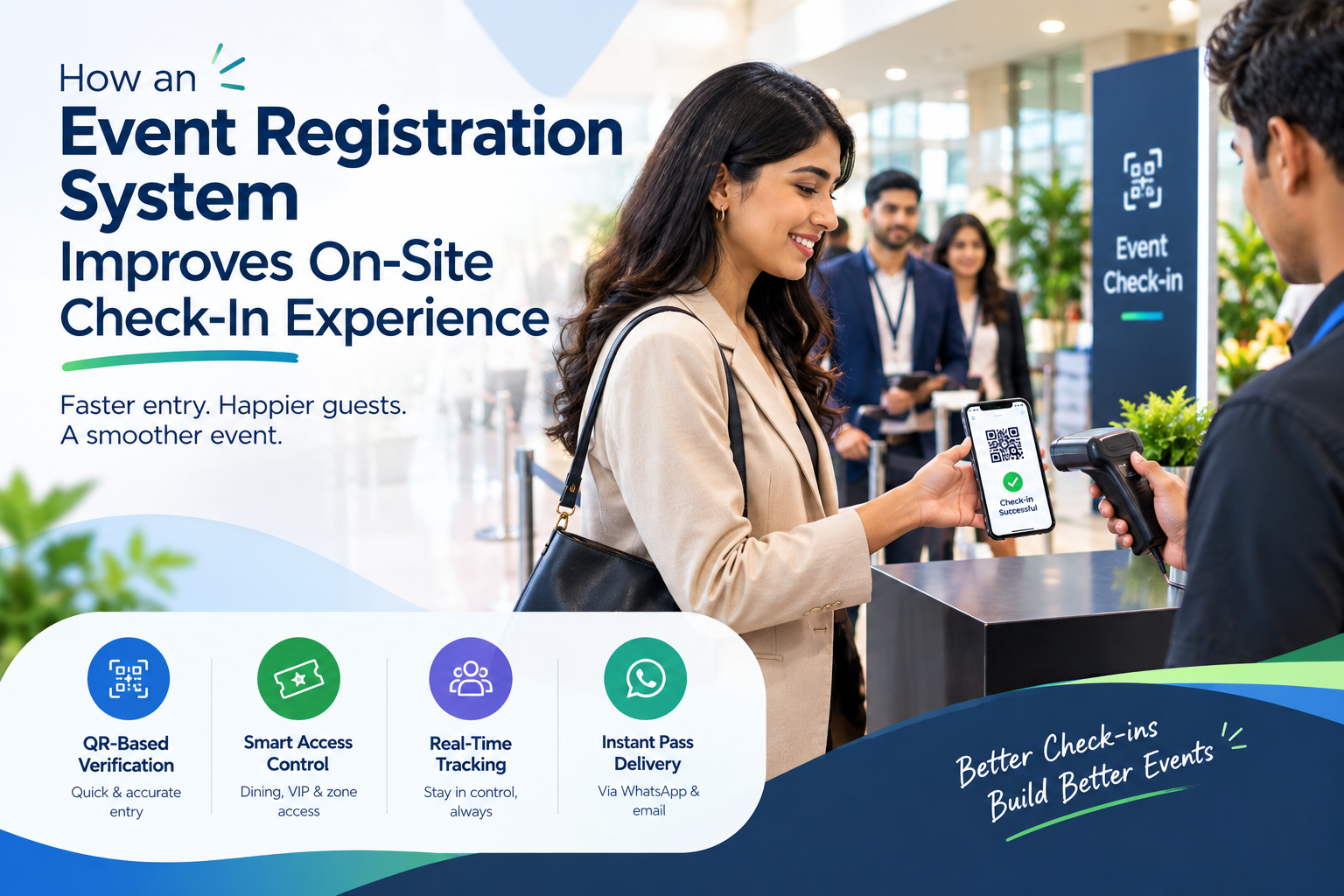
Think about the last event you walked into as a guest. Did you glide in smiling, or did you stand behind twelve people while someone squinted at a printed list looking for your name?
That first two minutes shapes how people feel about your entire event. An event registration system improves on-site check-in by giving every guest a verified digital pass, usually a QR code, so entry becomes a quick scan instead of a manual search. The result is a calmer gate, happier guests, and a first impression that actually matches the effort you put into the rest of the event.
Here is exactly how that improvement happens, and how AccessEase delivers it.
Quick Summary
- On-site check-in quality is decided by what happens before the guest arrives, not just at the gate.
- A QR-based system turns identity and ticket verification into a two-second scan.
- Access rules, like dining or zone entry, can be built into the pass itself.
- Real-time check-in data lets staff react before a queue builds.
- AccessEase adds WhatsApp delivery, so guests always have their pass ready.
What Actually Shapes the On-Site Check-In Experience?
The on-site check-in experience is shaped by how fast a guest’s identity and ticket can be verified, how clearly staff know what each guest is entitled to, and how visible the process is to organisers in real time. An event registration system controls all three, which is why it changes check-in so directly.
A good entrance does not feel like security. It feels like it’s being expected.
What guests notice, whether they say it or not
- How long they stand still before someone acknowledges them.
- Whether staff seem confident or are hunting for their name.
- Whether their special access, like a dining pass, gets questioned.
- Whether the queue behind them is moving or frozen.
- Whether the whole thing feels organised, even if it is a small event.
The gap between a good event and a good first impression
Here is a simple illustration. A guest waiting 90 seconds at the gate barely notices. A guest waiting 8 minutes, watching staff flip through pages, starts forming an opinion about your event before they have even seen the venue. The content inside rarely gets a fair chance after that.
How Does an Event Registration System Improve On-Site Check-In for Attendees?
It removes the guesswork from verification. Instead of staff reading names off a list and hoping it matches the right person, each guest carries a unique QR code created at registration. A single scan confirms identity, ticket type and any special access, so the interaction at the gate becomes fast, confident and consistent for every guest.
Four ways the experience changes for attendees
- No searching, no waiting on a name check. The code speaks for the guest.
- No confusion about what they can access. Dining, VIP or session-specific access is attached to their pass.
- No re-explaining themselves. If a plus-one or a company group registered together, the system already knows.
- No awkward disputes at the door. A valid scan settles it, without a debate in front of other guests.
Picture an awards night with a printed guest list at one table. Guests queue as staff scroll through pages, occasionally asking guests to spell their names twice. Some guests with dining passes get stopped again at the food counter for a second check.
Now picture the same evening with an event registration system. Guests arrive with a QR code already on their phone, sent to them on WhatsApp after they registered. One scan at the gate confirms entry and dining access together. No second stop, no second conversation.
The event is the same. The guest’s first two minutes are completely different.
Pro Tip: Brief your gate staff to greet first and scan second. A quick “Welcome, may I scan your code?” feels far better to a guest than a silent scan-and-wave.
Want your gate to feel this smooth? Talk to the AccessEase team for a quick walkthrough.
What Should Event Registration Software Offer for a Smooth Check-In?
Event registration software should offer instant QR or badge-based passes, access rules tied to ticket type, real-time check-in visibility, and reliable performance even under a rush. Anything that requires staff to make a judgment call at the door reintroduces the delay you are trying to remove.
Your on-site experience checklist
- Unique QR code or badge for every guest
- Delivery on a channel guests actually check, like WhatsApp
- Access rules linked to ticket type, not decided at the counter
- Support for free and paid events, and cash registrations
- Real-time check-in tracking, visible to organisers during the event
- Stable performance when many guests arrive together
- A branded, professional registration and pass experience
Printed list vs digital check-in
| At the gate | Printed list | Digital check-in with AccessEase |
| Verifying a guest | Reading and searching names | One QR scan |
| Special access (dining, zones) | Checked again separately | Confirmed in the same scan |
| Group or plus-one entries | Manually cross-referenced | Already linked at registration |
| Staff confidence | Depends on the list being current | Consistent, system-verified |
| Organiser visibility | None until counted manually | Live check-in dashboard |
How AccessEase Improves the Check-In Moment, Not Just the Registration Form
AccessEase is an event registration system designed around the actual moment a guest walks in, not just the sign-up page before it. Organisers can run free or paid events without changing how they normally work, and every guest’s pass carries exactly what they are entitled to.
As an event registration solution, AccessEase gives your on-site team:
- Instant QR passes: created automatically at registration, sent directly on WhatsApp.
- Built-in access control: dining or zone privileges are linked to the code, so validation happens at the same scan.
- Support for free and paid events: including cash registrations, without extra steps for staff.
- Real-time analytics: organisers can watch check-ins happen and respond to gate pressure immediately.
- Branded registration: guests experience a polished process from sign-up to entry.
- Integrations and support: fits your existing setup, with a team available when your event is live.
The improvement is not just fewer complaints. It is guests who walk in feeling like the event was ready for them.
Curious what this looks like at your venue? Contact us and see it in action.
Matching Your Event Registration Solution to Your Check-In Needs
The right event registration solution depends on your event’s shape, not just its size. A single-day meet-up has different check-in needs than a multi-day conference or a ticketed concert with several access zones.
- Single-day events: fast QR scan and a branded pass are usually enough.
- Multi-day events or conferences: you need day-wise passes, re-entry handling and per-day attendance data.
- Events with tiered access: dining, VIP or session-specific zones need access rules built into the pass itself, not decided by staff on the spot.
In Northeast India specifically, where WhatsApp is already the guest’s default app and cash payments are still common at many events, check that any registration software you shortlist actually supports these, rather than assuming an email-and-card-only tool will translate well on the ground.
Common On-Site Check-In Mistakes to Avoid
Common Mistake: Assuming the registration form is the finish line, and treating check-in as an afterthought.
- No dry run at the venue. Test scanning under real lighting and real Wi-Fi conditions before doors open.
- One gate for every guest type. Separate lanes for general entry, VIP and dining access reduce cross-checking.
- Untrained scanning staff. Everyone at the gate should know what to do with a failed or duplicate scan.
- No backup plan for connectivity issues. Ask any registration softwares you are considering about offline check-in mode before the event, not during it.
- Ignoring the live dashboard. If arrivals spike, that is your signal to open another lane, not to wait it out.
Conclusion
On-site check-in is the guest’s first real interaction with your event, and it deserves to be as thought-through as the stage or the menu. An event registration system improves that moment by replacing manual searching with a verified QR scan, attaching access rules to the pass itself, and giving organisers live visibility as guests arrive. AccessEase builds all of this into one system, from a branded sign-up page to a smooth scan at the door. Ready to give your guests a better first two minutes? Contact AccessEase and book a demo.
Frequently Asked Questions
Does the event registration system support badge printing at check-in?
Some event registration systems (AccessEase) support on-site badge printing, generating a physical badge the moment a guest checks in, which is common at conferences and trade shows. Others rely entirely on a digital QR pass, like on a guest’s phone. If badge printing matters for your event, confirm this specifically with any vendor before choosing, since not every event registration software includes it by default.
What makes an event registration system suitable for multi-day events?
An event registration system suited to multi-day events offers a single registration covering all days, day-wise or session-wise passes, re-entry handling, and attendance reporting broken down per day. It should also support several scanning gates and send reminders before each day, so returning guests do not need to search for their pass again. AccessEase provides these services.
Are there event registration systems with offline check-in mode?
Yes, some event registration systems like Accessease include offline check-in mode, where the guest list is downloaded to the scanning device in advance and scans are recorded locally, then synced once internet connectivity returns. This matters most at venues with unreliable Wi-Fi. Always ask a vendor directly and test offline scanning at your actual venue before relying on it for event day.