
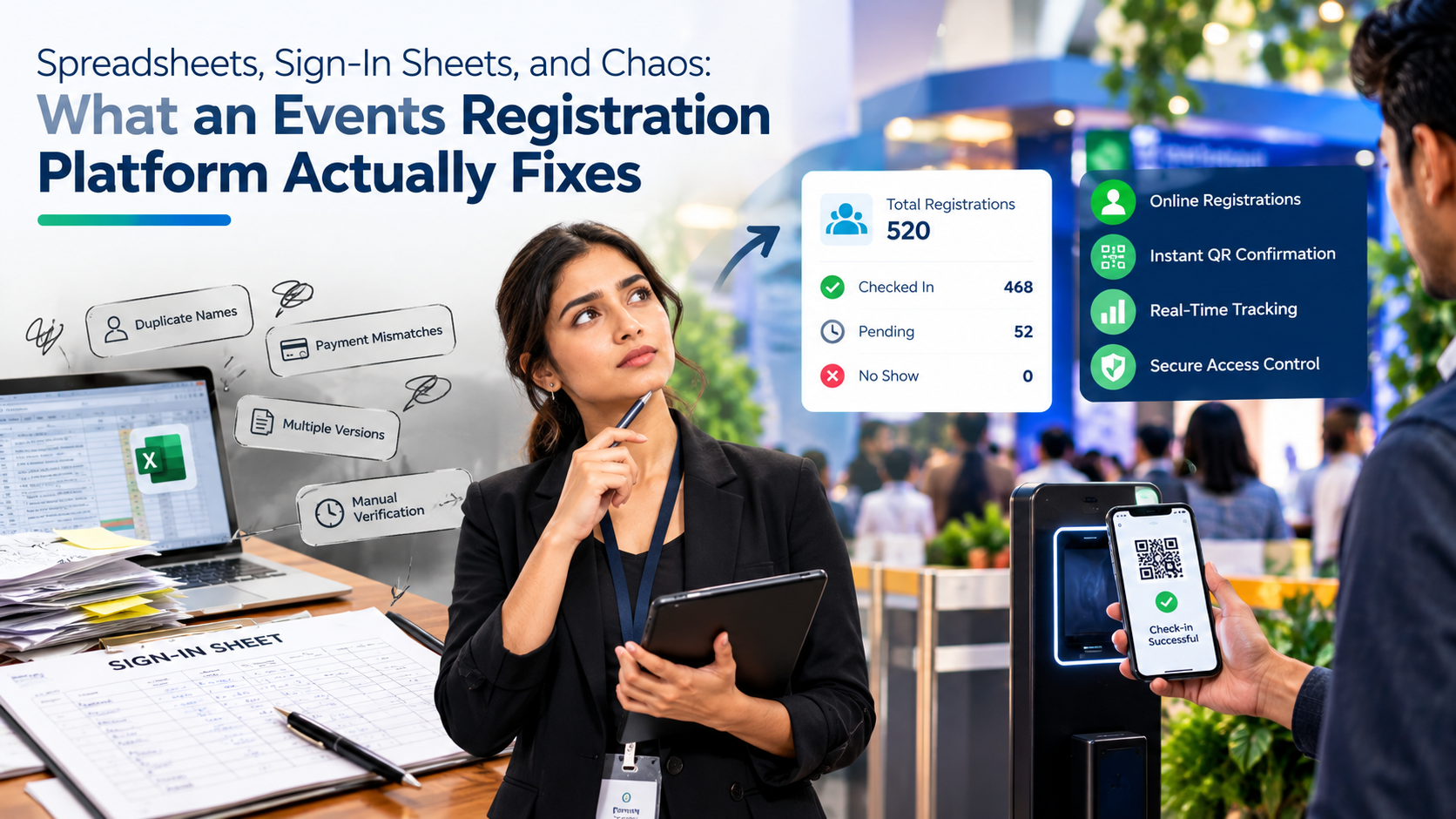
It is 9:40 pm, the event ended an hour ago, and you are still scrolling through a shared spreadsheet trying to figure out who actually showed up, who paid, and who is the “Rahul K” that appears three times with three different phone numbers.
An events registration platform fixes exactly this. It replaces spreadsheets and paper sign-in sheets with one connected system that collects guest details, confirms them instantly, verifies entry with a QR scan, and keeps every record accurate without anyone typing it in twice.
Let’s look at what spreadsheets genuinely cannot do, and how AccessEase handles it instead.
Quick Summary
- Spreadsheets are built to hold data, not to manage a live, moving crowd.
- Duplicate names, payment mismatches and version confusion are spreadsheet problems, not people problems.
- A QR-based system verifies each guest in seconds, with no manual search.
- Real-time tracking shows you gate pressure while it is still fixable.
- AccessEase handles registration, confirmation, access control and check-in in one place.
Why Do Organisers Still Reach for Spreadsheets, and Where Do They Break?
Organisers use spreadsheets because they are familiar, free and easy to start. They break down once an event has more than a handful of guests, because spreadsheets cannot verify identity, confirm payment automatically, or handle a queue of people arriving at once.
A spreadsheet is a list. An event needs a system.
Where spreadsheets fall apart
- Multiple people edit the same file and create conflicting versions.
- Names get entered twice, misspelled, or left incomplete.
- Payment status has to be checked manually against a bank statement.
- Nobody can search 500 rows fast enough while a queue is waiting.
- There is no way to confirm a guest actually is who the row says they are.
The hidden cost of a spreadsheet-run event
Here is a simple illustration. If a staff member spends 15 seconds scrolling and matching each name at the gate, 300 guests take 75 minutes of pure searching, assuming nobody argues about a missing entry. Add real disputes, and it stretches further.
That is the moment guests remember, not your décor or your speakers.
What Problems Does an Events Registration Platform Solve That Spreadsheets Can’t?
It solves identity verification, live capacity tracking and instant confirmation, none of which a spreadsheet can do on its own. Guests register once, receive a unique QR code, and staff scan it at the gate. The system checks the guest against the record automatically, updates the count, and flags duplicates, so nothing depends on a person reading a row correctly under pressure.
Five things spreadsheets cannot do
- Verify a guest instantly. A spreadsheet shows a name; a QR scan confirms the actual person against their registration.
- Update in real time. Every check-in reflects immediately, with no refreshing or emailing the latest version around.
- Catch duplicates automatically. No more three “Rahul K” rows with no way to tell which one is real.
- Link access rules to a guest. Dining, VIP or restricted-area access is not just a note in a column; it is enforced at the scan.
- Handle a rush without breaking. Fifty people arriving in the same two minutes is a queue problem for a spreadsheet, and a routine scan for a QR system.
Picture an organiser managing sign-ups through a shared spreadsheet. Two team members edit it separately. By event day, there are two versions, mismatched payment notes, and no way to know who is actually inside the venue.
Now picture the same launch on an events registration platform. Every sign-up lands in one record. Guests get a QR code the moment they register. At the gate, staff scan and the dashboard updates live, so the organiser always knows exactly how many guests are in.
One version of the truth, instead of three.
Pro Tip: If you are still using a spreadsheet, at minimum lock it to one editor before the event. Better yet, move to a platform where the record updates itself.
Tired of chasing spreadsheet versions? Talk to the AccessEase team for a quick walkthrough.
What Should an Event Registration Solution Actually Include?
A genuine event registration solution should include a branded sign-up page, instant QR confirmation, support for free and paid tickets, access control by ticket type, and real-time reporting. Anything less is still, functionally, a spreadsheet with extra steps.
Your checklist for a real solution
- A short, branded sign-up page
- Unique QR code for every registered guest
- Confirmation on a channel guests actually check, like WhatsApp
- Free and paid registration, with multiple ticket categories
- Online and cash registration handling
- Access control linked to ticket type
- Real-time check-in tracking and analytics
- Support that responds when your event is live
Spreadsheet vs events registration platform
| What you need | Spreadsheet + sign-in sheet | AccessEase |
| Guest confirmation | Manual reply or none | Instant, on WhatsApp |
| Identity check at entry | Reading a name aloud | QR scan |
| Duplicate detection | Manual, often missed | Automatic |
| Payment tracking | Cross-checked by hand | Recorded with registration |
| Special access (dining, zones) | A note in a column | Enforced at the scan |
| Live headcount | Unknown until counted | Real-time on a dashboard |
How AccessEase Replaces the Spreadsheet Entirely
AccessEase is an events registration platform built around how events actually run, not around rigid processes. Organisers can set up free or paid events without changing their usual workflow. A small get-together may only need free sign-ups, while a concert may need several paid ticket categories.
As an event registration solution, AccessEase gives you:
- One connected record: every sign-up, payment and check-in in a single place, not three files.
- Instant QR codes: unique per guest, delivered straight to WhatsApp.
- Access control: dining or zone access is linked to the QR code, so there is no arguing at the counter.
- Real-time analytics: registrations and check-ins update live.
- A branded sign-up page: simple for guests, matched to your identity.
- Integrations and support: fits your existing tools, with a team on hand when it matters.
No more three versions of the same file. Just one system that stays accurate on its own.
Ready to retire the spreadsheet? Visit AccessEase and see how it works.
Choosing Between Event Registration Platforms When You Outgrow the Spreadsheet
The right event registration platforms for you depend on how fast your event grows and how much you need verified at the door. A one-time small gathering may survive on a spreadsheet. Anything recurring, paid, or crowd-heavy needs a real system.
- One-off, small, free events: a spreadsheet might just about work, though a simple platform still saves time.
- Paid or access-controlled events: you need ticket categories, payment tracking and enforced access rules.
- Large or fast-arriving crowds: you need QR scanning and live tracking, or the gate becomes the bottleneck.
In Northeast India, where WhatsApp is the default channel and cash payments remain common, check that any event registration solution you shortlist actually supports these, rather than assuming email and card-only tools will fit.
Common Mistakes People Make With Registration Data
Common Mistake: Trusting a spreadsheet to scale just because it worked for a smaller event last time.
- Multiple editors, one file. Version conflicts are almost guaranteed.
- No identity check at the door. A name on a list is not proof of who arrived.
- Manual payment matching. It is slow and easy to get wrong under pressure.
- Skipping reviews before choosing a tool. Read registration software reviews and ask about support response time, not just features.
- No live view of the gate. Without real-time data, you only learn about a bottleneck after it has formed.
Conclusion
Spreadsheets were never built to manage a live, moving crowd, and that gap is exactly what an events registration platform fixes. It replaces guesswork with verified identity, manual matching with automatic records, and a static list with a live, accurate picture of your event. AccessEase brings registration, QR-based entry, access control and real-time tracking together in one system, so your event day runs on data you can trust. Ready to move on from spreadsheets? Visit accessease.in and book a demo.
Frequently Asked Questions
Is an event registration platform worth it for a single small event?
For a very small, free, one-time event, a simple form may be enough. But even for a single small event, an event registration platform like AccessEase saves time on confirmations and prevents duplicate or unclear entries. If the event involves payment or access rules of any kind, it is worth setting up properly, since problems still happen at a small scale.
What do people complain about most in event registration platform reviews?
Common complaints in event registration platform reviews include poor customer support during live events, confusing setup, hidden fees on paid plans, weak offline or low-connectivity performance, and limited support for local payment methods. Before choosing a tool like AccessEase, check reviews specifically for support responsiveness on event day, since that is when problems are most costly.
How do the top event registration platforms handle last-minute rush sign-ups?
The top event registration platforms handle last-minute rush sign-ups with a fast, simple form, instant QR confirmation, and real-time capacity tracking, so a sudden spike does not overwhelm staff. AccessEase confirms guests immediately on WhatsApp and updates its dashboard live, so organisers can see a rush happening and respond with an extra scanning lane if needed.